Betelgeuse, the red supergiant that marks Orion’s shoulder, has been closely watched since its Great Dimming in late 2019 and early 2020. A new multi-frequency radio study now reports two linked results: the star’s extended atmosphere has largely recovered at the wavelengths that looked unusually cool before that episode, and the outline of that atmosphere appears to change in step with the orbit of a close companion named Siwarha.
The work, led by Lynn D. Matthews of MIT Haystack Observatory and published in The Astronomical Journal, combines observations from the U.S. National Science Foundation’s Karl G. Jansky Very Large Array (NSF VLA) and the Atacama Large Millimeter/submillimeter Array (ALMA). Between 2021 and 2026 the team measured Betelgeuse at seven frequencies from 22 to 485 gigahertz. Different radio frequencies probe different depths, so the data build a layer-by-layer view from just above the visible surface out to several times the star’s radius.
Evidence that a companion disturbs Betelgeuse’s atmosphere
Siwarha itself is too faint to appear in these radio maps. Earlier optical imaging and spectroscopy had already pointed to a companion orbiting deep inside Betelgeuse’s extended atmosphere, at roughly 2.3 times the giant’s radius. Matthews and colleagues instead tracked the radio disk’s ellipticity across epochs. The atmosphere looks more elongated near the times when Siwarha should be near maximum elongation as seen from Earth, and rounder when the companion is expected to pass in front of or behind the star.
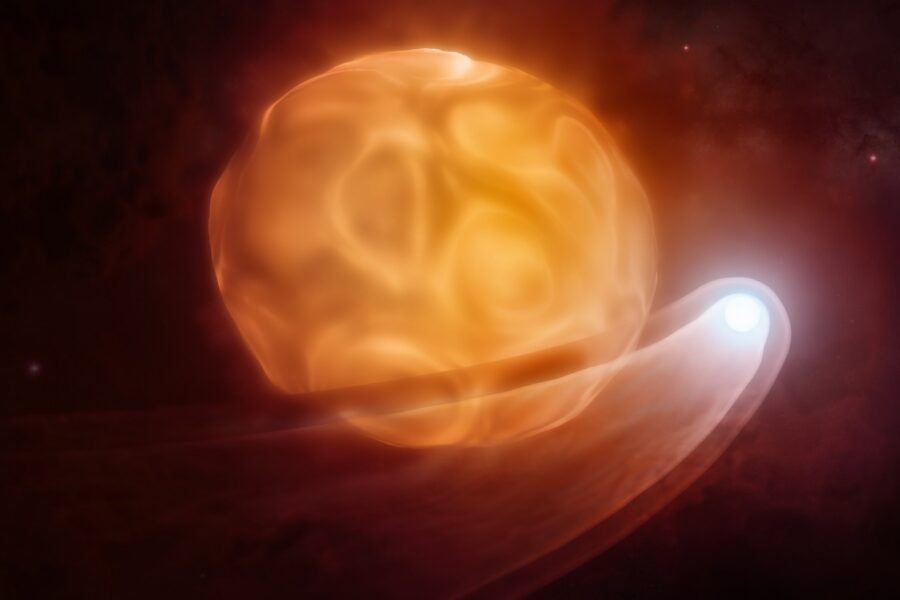
That pattern is consistent with a companion stirring Betelgeuse’s outer layers as it moves through them, possibly leaving a wake in the gas. The authors are careful about the claim: the correlation supports periodic atmospheric perturbations, and more observations covering a fuller stretch of the orbit are still needed to test the interpretation.
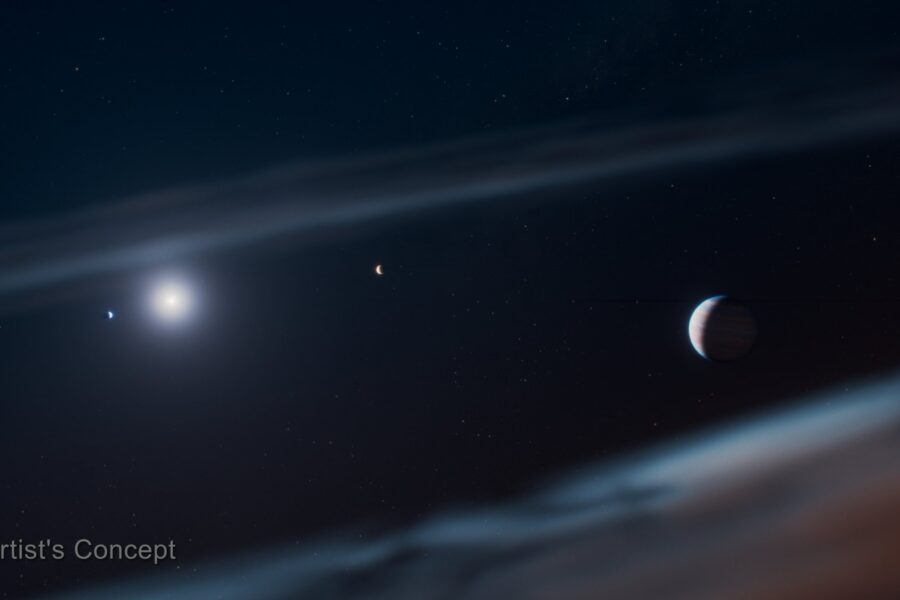
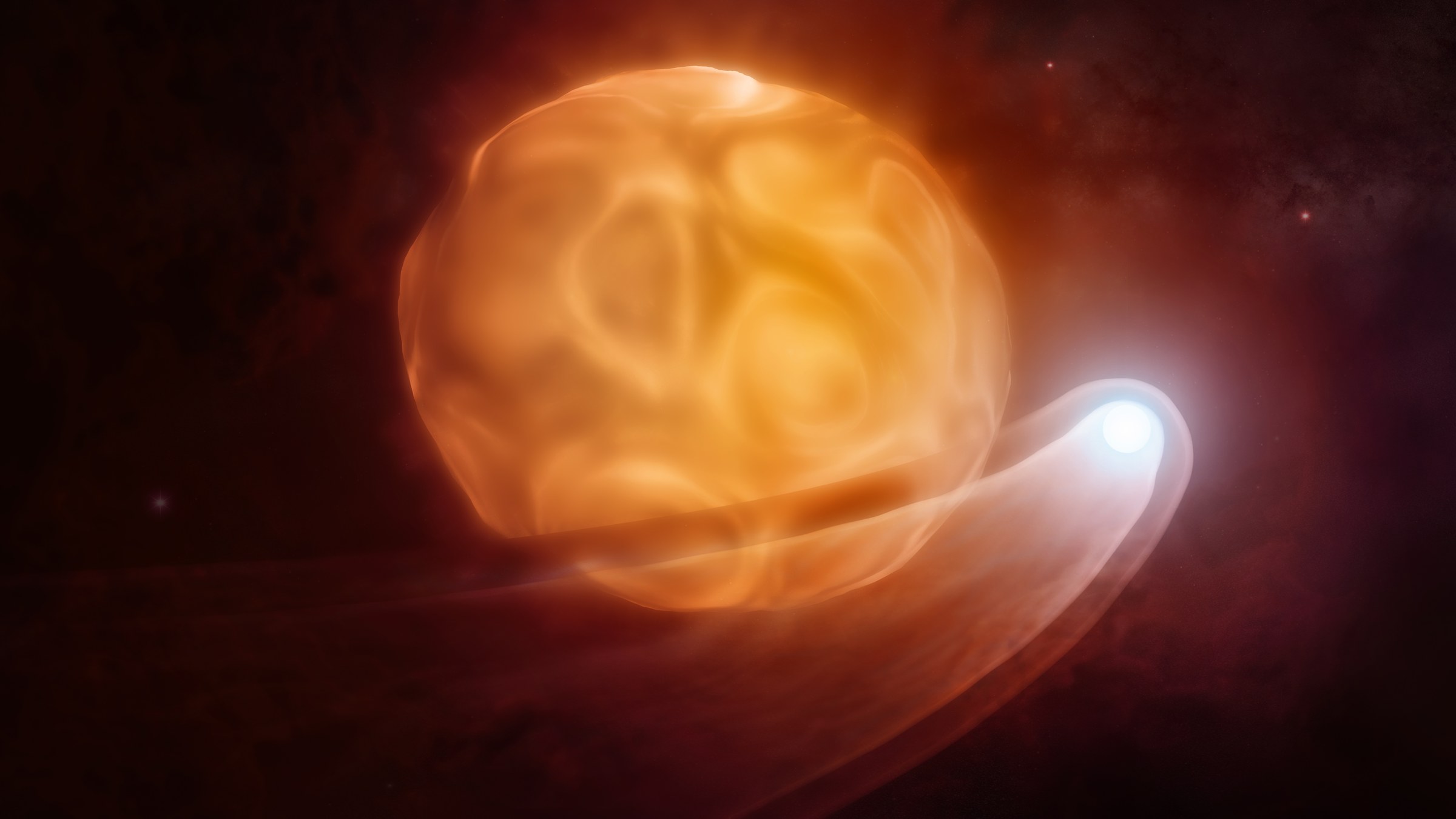
Artist’s illustration of the companion Siwarha moving through Betelgeuse’s outer atmosphere and leaving a wake. This is not a telescope image of the companion. Credit: NSF/AUI/NSF NRAO/M. Weiss.
A cool layer and a recovery after the Great Dimming
The same campaign confirms a cool region between Betelgeuse’s photosphere and its chromosphere. At the highest ALMA frequency in the study, which probes closest to the visible surface, the team measured a brightness temperature of about 2,200 kelvin—more than 1,000 degrees cooler than the star’s nominal surface temperature. Farther out, near about 2.7 stellar radii, the brightness temperature reaches roughly 3,500 kelvin.
At the VLA frequencies that had shown unusually low values in 2019, just before the Great Dimming, the new measurements have climbed back toward more typical levels. Brightness temperature describes the temperature corresponding to the radiation the telescope detects; it is a useful gauge of the mean electron temperature in optically thick radio layers, not a single thermometer reading for the whole star.
The global radio spectrum remains consistent with optically thick thermal emission. Across more than two decades in frequency the team finds a spectral index of 1.35 ± 0.03, with no clear break that would signal a strong contribution from cool dust at the higher ALMA bands.
What remains uncertain
Siwarha’s exact nature is still debated, and the companion was not detected directly at radio wavelengths—its expected thermal flux sits well below the noise floor of these images. Position angles of the fitted ellipses also differ by frequency, which may mean different atmospheric depths are tracing different parts of a three-dimensional disturbance rather than a single flat oval. Future campaigns, including work expected with the Next Generation Very Large Array, should sample more of the orbit and more of the atmosphere.
For now, the ALMA and VLA results add radio evidence to an already growing case that Betelgeuse is not a solitary red giant. Its famous outer envelope appears shaped, at least in part, by a close companion moving through the gas that will eventually become a supernova remnant.
Sources
Sources
- ALMA Observatory press release — ALMA and VLA Reveal Signs of a Companion Stirring Betelgeuse’s Atmosphere (30 Oct 2026). Consulted 2026-11-01.
- NSF NRAO press release — What Lurks Within the Shadows of Betelgeuse?. Consulted 2026-11-01.
- Matthews et al. 2026, The Astronomical Journal — New Spatially Resolved Observations of Betelgeuse from the VLA and ALMA. Consulted 2026-11-01.
- arXiv:2608.02847 — Preprint of the same Astronomical Journal paper. Consulted 2026-11-01.