Beta Pictoris may be one of the most closely watched young star systems in the sky. It is 63 light-years away and about 23 million years old, surrounded by a bright edge-on disk of dust and debris, and home to Beta Pictoris b, one of the first exoplanets ever directly imaged. Astronomers have studied it for decades. Even so, a third giant planet went unnoticed until 2026.
NASA announced Beta Pictoris d on July 15, 2026, along with a study by Aidan Gibbs of the University of California, San Diego, published in the Astrophysical Journal Letters. A separate team led by Ben Sutlieff of the University of Edinburgh and Markus Bonse of the European Southern Observatory confirmed the planet independently in the same journal.
Found by its fingerprint
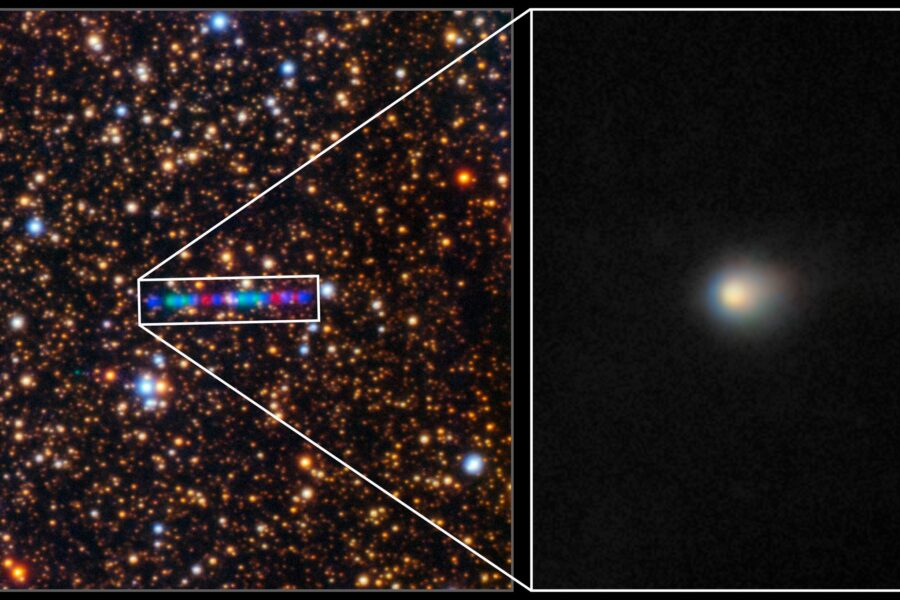
The team was not searching for a new planet. Using the integral field unit on the James Webb Space Telescope’s NIRSpec instrument, which records a spectrum for every pixel in an image, they were studying the atmosphere of Beta Pictoris b. At one position, where they expected to see only a smooth spectrum from starlight scattered by dust, they saw a series of narrow absorption lines that matched carbon monoxide.
That pattern is typical of a giant planet’s atmosphere. Bright spots in disk images are often artifacts or dust clumps. “We’ve learned not to trust bright blobs in images,” said Jean-Baptiste Ruffio of UC San Diego, principal investigator of the Webb observations where the signal appeared.
The spectrum also showed the object’s motion. By measuring the Doppler shift of its lines, the team found its radial velocity, position, and alignment with the disk all match an object orbiting Beta Pictoris, not a background star or brown dwarf. Follow-up observations with Webb’s MIRI instrument detected water vapor and methane.
NASA calls Beta Pictoris d the first directly imaged planet discovered primarily through moderate-resolution spectroscopy.
Hidden in plain sight for 11 years
Once they knew where to look, Sutlieff and Bonse found the planet in new ground-based images from the ERIS instrument at ESO’s Very Large Telescope, as well as in older data from Webb’s NIRCam and VLT/SPHERE. Their position measurements cover about 11 years and show the orbital motion expected from a bound planet. The planet was in earlier data, but it was hard to separate from the bright debris disk.
What we know about the planet, and how confident we are
The estimates are still uncertain. NASA’s summary says the planet is likely at least twice Jupiter’s mass, making it the lightest of the system’s three known giants, with an orbit around 30 astronomical units, about Neptune’s distance from the Sun. The Sutlieff team’s orbit fit gives a semimajor axis of about 26 astronomical units (with an asymmetric uncertainty of roughly minus 6 and plus 2) and, based on evolutionary models, a mass of about 2.4 ± 0.6 Jupiter masses and a temperature near 600 kelvin. These numbers depend on models that assume the planet’s age and formation history, so they may change with more observations.
The Edinburgh-led team also found that the planet’s colors indicate strong carbon dioxide absorption and suggest an atmosphere richer in heavy elements than free-floating objects of similar age and temperature. They noted it closely resembles 51 Eridani b, another young planet in the same stellar group.
Why it matters
There are two main takeaways. First, the planet may explain an old puzzle in the system. Astronomers had predicted an outer planet could account for the debris disk’s sharp inner edge, and Beta Pictoris d’s orbit, in the same plane as the inner planets and just inside the disk, fits this idea. NASA says it makes Beta Pictoris only the second known system with at least three imaged planets.
Second, the method could be used elsewhere. Many young stars have bright disks where planets are hard to detect. Searching for molecular fingerprints instead of bright spots can help astronomers find planets that traditional coronagraphic imaging misses. The Edinburgh team also pointed out that this result shows what future ground-based telescopes like ESO’s Extremely Large Telescope might achieve.
The researchers plan to keep analyzing Webb data to improve estimates of the planet’s temperature, chemistry, and orbit.
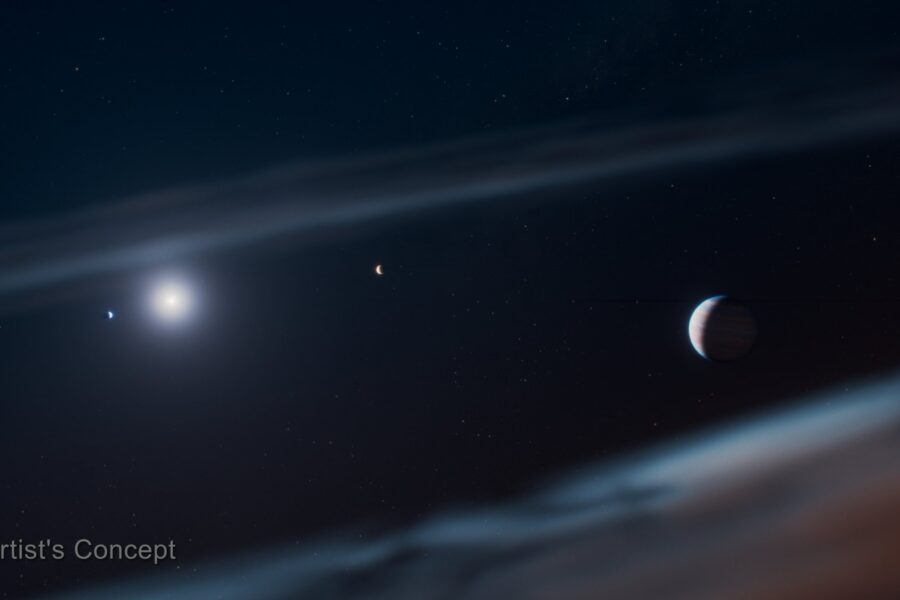
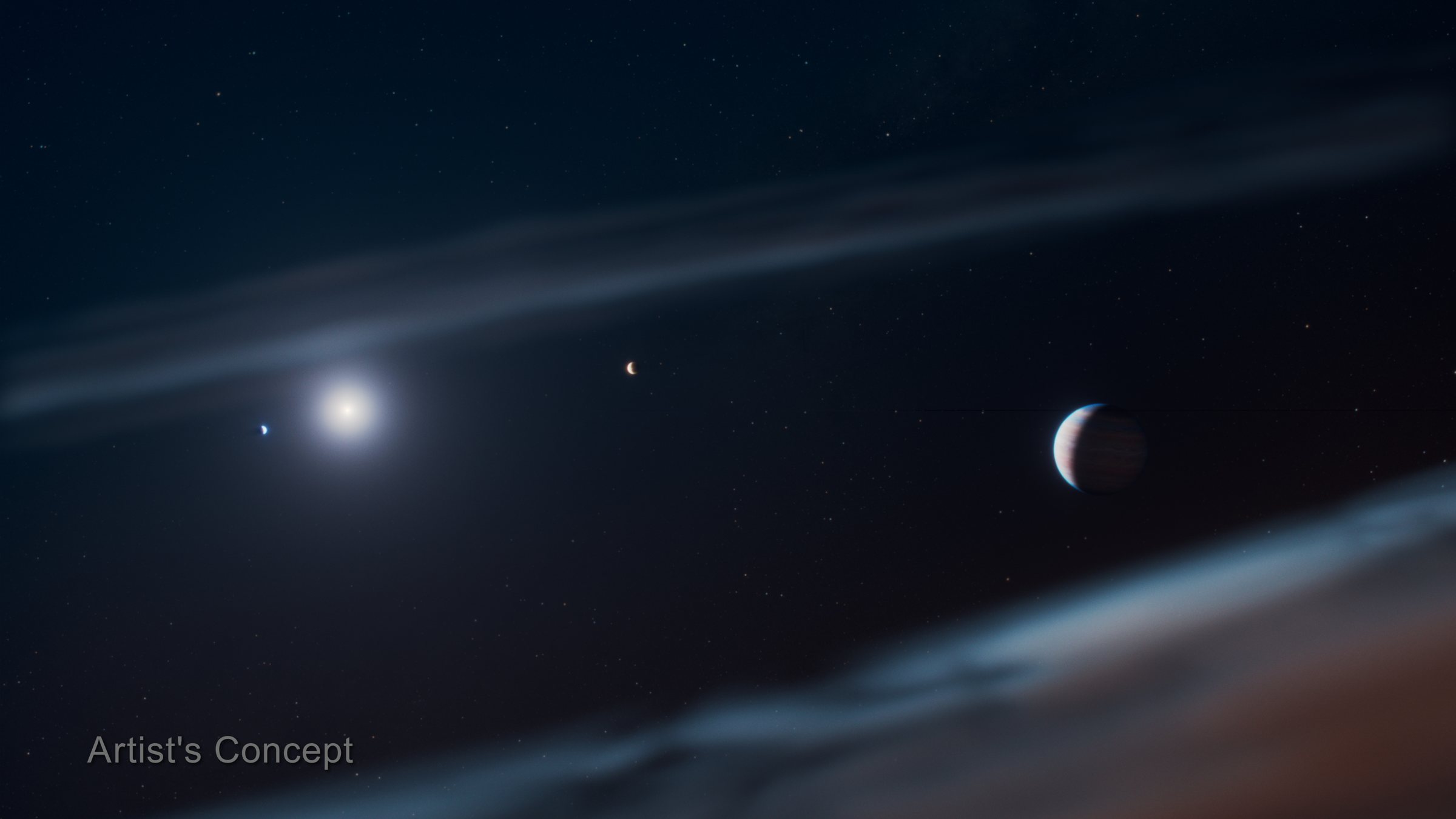
Image: Illustration: NASA, ESA, CSA, STScI, Ralf Crawford (STScI). Artist’s concept, not an image of the planet.
Sources
Sources
- NASA’s Webb Discovers Hidden Planet in Famous Star System — NASA Science, July 15, 2026. Consulted 2026-10-31.
- Direct Imaging Discovery of Giant Exoplanet β Pictoris d: A Decade-Long Game of Hide-and-Seek (Sutlieff, Bonse et al.) — The Astrophysical Journal Letters 1006, L10 (2026). Consulted 2026-10-31.
- Beta Pictoris System (Artist’s Concept) — NASA Science image asset. Consulted 2026-10-31.
- Beta Pictoris System (NIRSpec IFU Image and Spectrum) — NASA Science image asset. Consulted 2026-10-31.
- Beta Pictoris System (NIRSpec IFU Image Annotated) — NASA Science image asset. Consulted 2026-10-31.