Comets are leftovers. Each one is a lump of ice and dust that never made it into a planet, and so it keeps a chemical record of the place where it formed. For every comet studied before 2017, that place was our own solar system. Comet 3I/ATLAS is different, and the record it carries now looks very old.
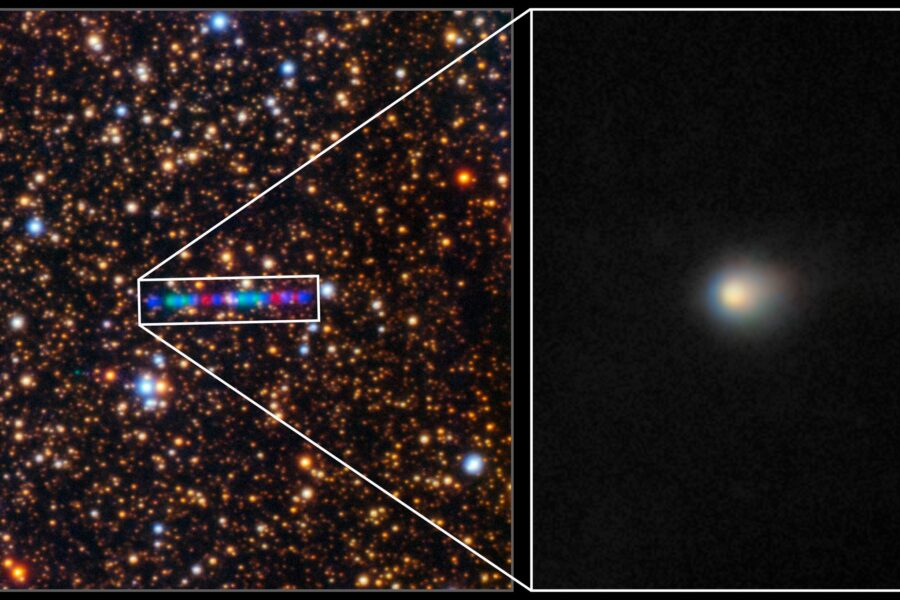
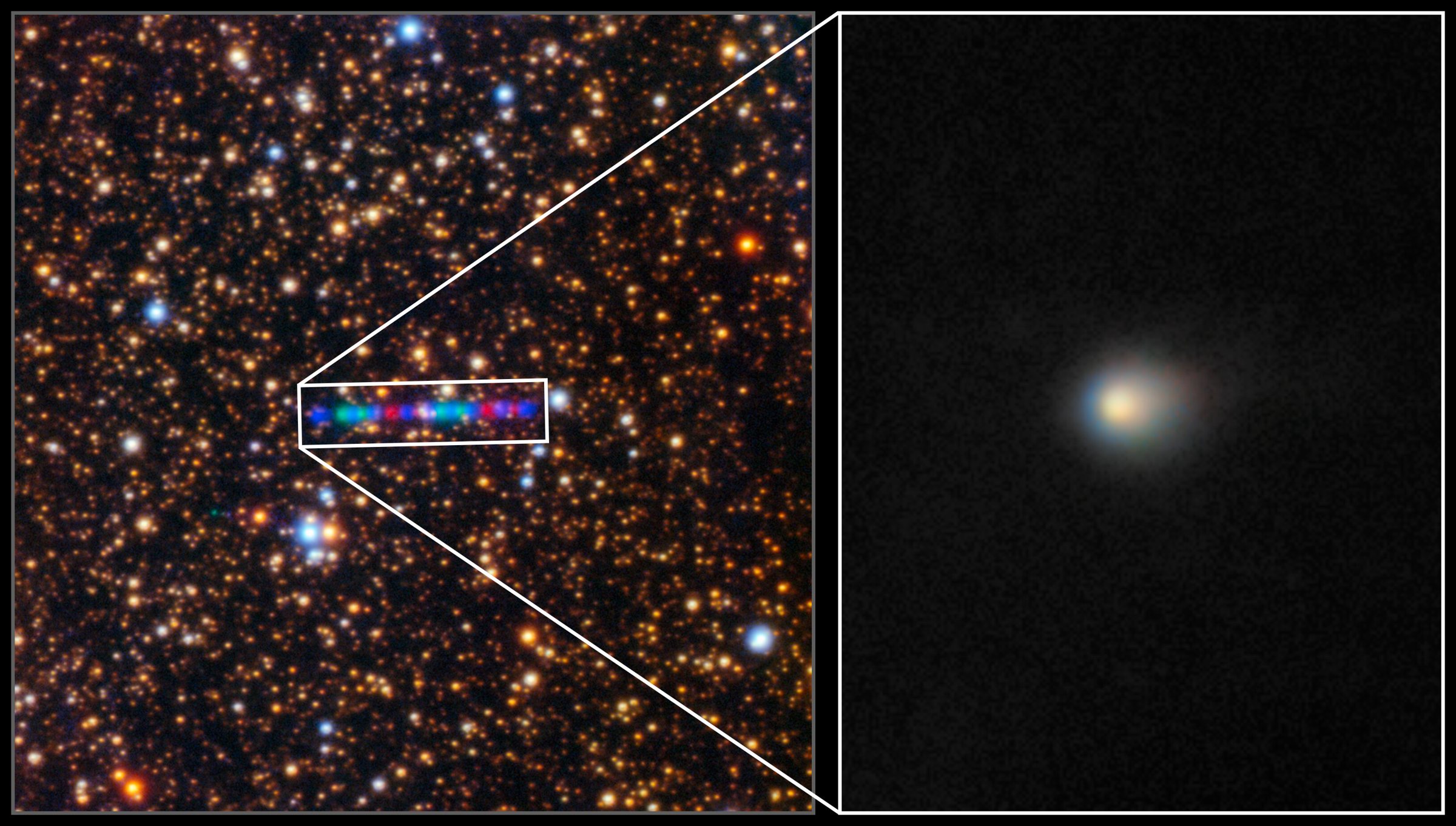
The ATLAS survey, a NASA-funded asteroid warning network, first spotted the object on July 1, 2025. Its fast, open-ended hyperbolic path showed it was not bound to the Sun, which made it only the third confirmed interstellar object, after 1I/’Oumuamua in 2017 and 2I/Borisov in 2019. Unlike ‘Oumuamua, it was clearly an active comet, and it was bright enough for nearly every large observatory to study as it swept past the Sun in late 2025.
What Webb measured
In December 2025, as the comet moved away from the Sun with a freshly warmed coma, a team led by Martin Cordiner of NASA’s Goddard Space Flight Center used the James Webb Space Telescope’s NIRSpec instrument to take its spectrum. The results, published in Nature on June 22, 2026, focus on two isotope ratios that chemists treat almost like a birth certificate.
The first is deuterium, or heavy hydrogen, in water. The team measured a D/H ratio of about 0.98 percent. NASA describes that as roughly 30 times the level seen in solar system comets. Water ice gets enriched in deuterium at very low temperatures, and warmth tends to reset it, so the authors conclude that most of the comet’s ice formed below about 30 kelvin and was never substantially reheated.
The second is carbon. In carbon dioxide and carbon monoxide, the team found 12C/13C ratios of roughly 123 to 191, well above typical solar system values. Carbon-13 builds up in the galaxy as generations of stars live and die, so a shortage of it suggests material that formed early, before much enrichment had happened.
In the Nature paper, the team suggests 3I/ATLAS may have accreted as long as about 12 billion years ago; NASA’s summary gives a 10-to-12-billion-year window, versus 4.5 billion years for the Sun.
Independent lines point the same way
Webb was not alone. A separate JWST study in Nature Astronomy measured deuterated methane in the coma and found a methane D/H ratio about 13 times that measured at comet 67P by ESA’s Rosetta mission. Using ESO’s Very Large Telescope, a team led by Cyrielle Opitom of the University of Edinburgh measured carbon and nitrogen isotopes in cyanide gas and concluded that the comet likely formed in the outer regions of a low-metallicity star system, one poor in elements heavier than helium. ESO’s summary puts the comet at more than twice the Sun’s age.
Radio observations add another piece. Using the ALMA array in Chile, astronomers found 3I/ATLAS unusually rich in methanol compared with hydrogen cyanide, with ratios of about 70 and 120 on two dates. Methanol appeared to come from both the nucleus and icy grains in the coma, while hydrogen cyanide came mostly from the nucleus.
What we still cannot know
These results describe conditions, not an address. The Nature authors note that tracing the comet’s orbit back more than about 10 million years is not reliable, because gravitational nudges inside the Milky Way scramble the path. No one can point to the star that 3I/ATLAS came from, and the age estimate depends on models of how the galaxy’s chemistry changed over time. A different enrichment history would shift the numbers.
There is also a sampling problem. Telescopes measure gas released from the surface and the coma, which may not perfectly represent the comet’s interior. And with only three interstellar objects known, it is hard to say whether 3I/ATLAS is typical or an outlier.
Why it matters for astronomy
Even with those caveats, this is the first time astronomers have measured isotope ratios this detailed in material from another planetary system. NASA co-author Stefanie Milam framed it in terms of prebiotic chemistry: so far, Earth is the only place where we know chemistry led to life, and interstellar comets let researchers compare those ingredients with material from elsewhere.
More visitors should follow. The Vera C. Rubin Observatory began its 10-year Legacy Survey of Space and Time in June 2026 and will scan the southern sky every few nights, so the next interstellar comet will probably be found earlier and studied longer. 3I/ATLAS has already shown what that kind of study can reveal.
Image: International Gemini Observatory/NOIRLab/NSF/AURA/K. Meech (IfA/U. Hawaii); Image Processing: Jen Miller & Mahdi Zamani (NSF NOIRLab), CC BY 4.0.
Sources
Sources
- Isotopic evidence for a cold and distant origin of 3I/ATLAS (Cordiner et al.) — Nature, 2026. Consulted 2026-10-31.
- NASA’s Webb Finds Clues to Ancient, Distant Origin of Comet 3I/ATLAS — NASA Science, June 22, 2026. Consulted 2026-10-31.
- An enriched methane D/H ratio in the interstellar object 3I/ATLAS — Nature Astronomy, 2026. Consulted 2026-10-31.
- Older than the Sun: Astronomers find new clues to the origin of interstellar comet 3I/ATLAS — ESO, eso2608. Consulted 2026-10-31.
- An interstellar comet packed with alcohol? What ALMA found in 3I/ATLAS — Phys.org, March 2026. Consulted 2026-10-31.
- Gemini North Observes Comet 3I/ATLAS — NSF NOIRLab, July 15, 2025. Consulted 2026-10-31.
- Rubin Observatory begins the Legacy Survey of Space and Time — Rubin Observatory, June 30, 2026. Consulted 2026-10-31.