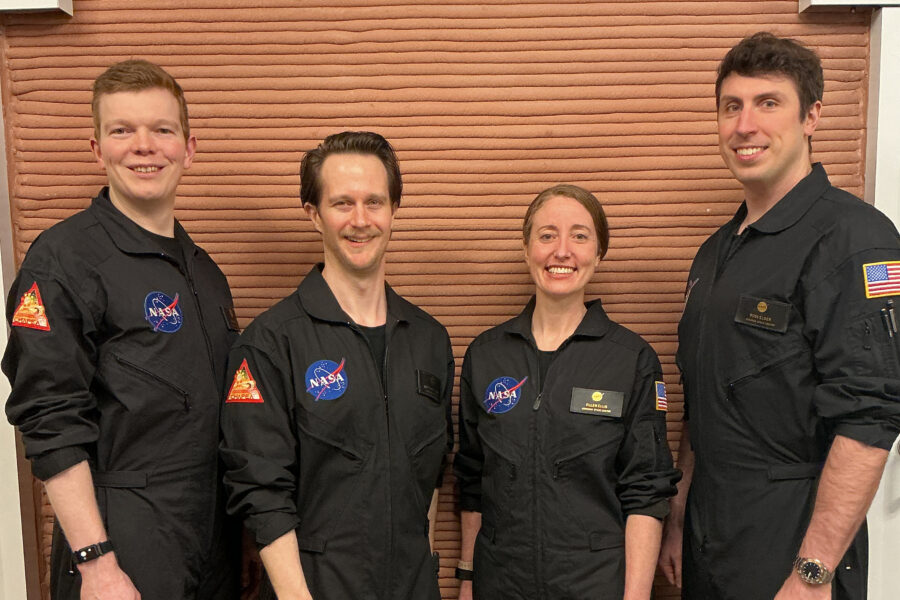
Four research volunteers stepped out of a 3D-printed Mars habitat at NASA’s Johnson Space Center on Saturday, October 31, 2026, ending 378 days of isolation in the agency’s second Crew Health and Performance Exploration Analog, or CHAPEA, mission.
Commander Ross Elder, medical officer Ellen Ellis, science officer Matthew Montgomery, and flight engineer James Spicer had entered the 1,700-square-foot facility on October 19, 2025. Their job was not to pretend they were on Mars for spectacle. It was to live and work under conditions NASA expects future deep-space crews to face, so researchers could gather health and performance data before people attempt long stays on the Moon or Mars.
NASA streamed the egress ceremony live from Houston. Johnson Space Center Director Vanessa Wyche and NASA astronaut Jack Hathaway spoke as the crew left the habitat, and the volunteers began about two weeks of post-mission evaluations and debriefs with NASA scientists.
Life inside a simulated Mars habitat
CHAPEA Mission 2 ran inside Mars Dune Alpha, a 3D-printed habitat designed to stand in for a surface outpost. According to NASA, the crew’s routine mixed high-tempo simulated Marswalks, robotic operations, habitat maintenance, exercise, and crop cultivation. Resource limits, equipment failures, and prolonged isolation were built into the study so teams could watch how people adapt when help from Earth is slow or incomplete.
Communication was deliberately constrained. NASA’s mission overview describes Mars-like delays of about 22 minutes in each direction during the analog, a lag that forces crews to solve problems with more autonomy than astronauts enjoy on the International Space Station. Family contact during the mission was limited to delayed email, NASA said as the one-year mark approached.
Those constraints matter for Artemis and for any later Mars plan. Michael Stenger, chief scientist for NASA’s Human Research Program, said ahead of egress that combining a Mars-realistic analog with physiological, psychological, and performance measurements should help translate lessons to a Moon base and beyond. Grace Douglas, CHAPEA principal investigator, called the crew’s year of fast-paced work a demanding commitment and said the team looked forward to congratulating them in person.
What the data are for
NASA frames CHAPEA as part of the Human Research Program’s effort to keep crews healthy and productive on long missions. The agency says results can inform food-system design, how crews use limited time, how much Deep Space Network bandwidth they need, and how flight doctors and psychologists support people who cannot get a real-time consult from Earth.
The analog is not a substitute for flying in space. Gravity, radiation, and the vacuum of space are absent. What it can test is the human side of confinement: sleep, teamwork, medical care under delay, exercise on limited hardware, and the grind of maintaining a small habitat for more than a year. Mission 2 follows an earlier CHAPEA crew that also spent 378 days in the same facility in 2023 and 2024.
A step toward longer stays away from Earth
NASA has not claimed that CHAPEA alone clears the path to Mars. The agency’s own description is more careful: the simulation produces data that can help planners decide where technology and procedures need work, and where the hard parts of a year away from Earth are not as hard as feared.
For now the Mission 2 crew is back in Houston sunlight, starting the quieter work of handing their year of measurements to the scientists who designed the study. If those results sharpen how NASA feeds, schedules, and supports crews on Artemis and later Mars missions, the 378 days inside a printed habitat will have done the job they were asked to do.
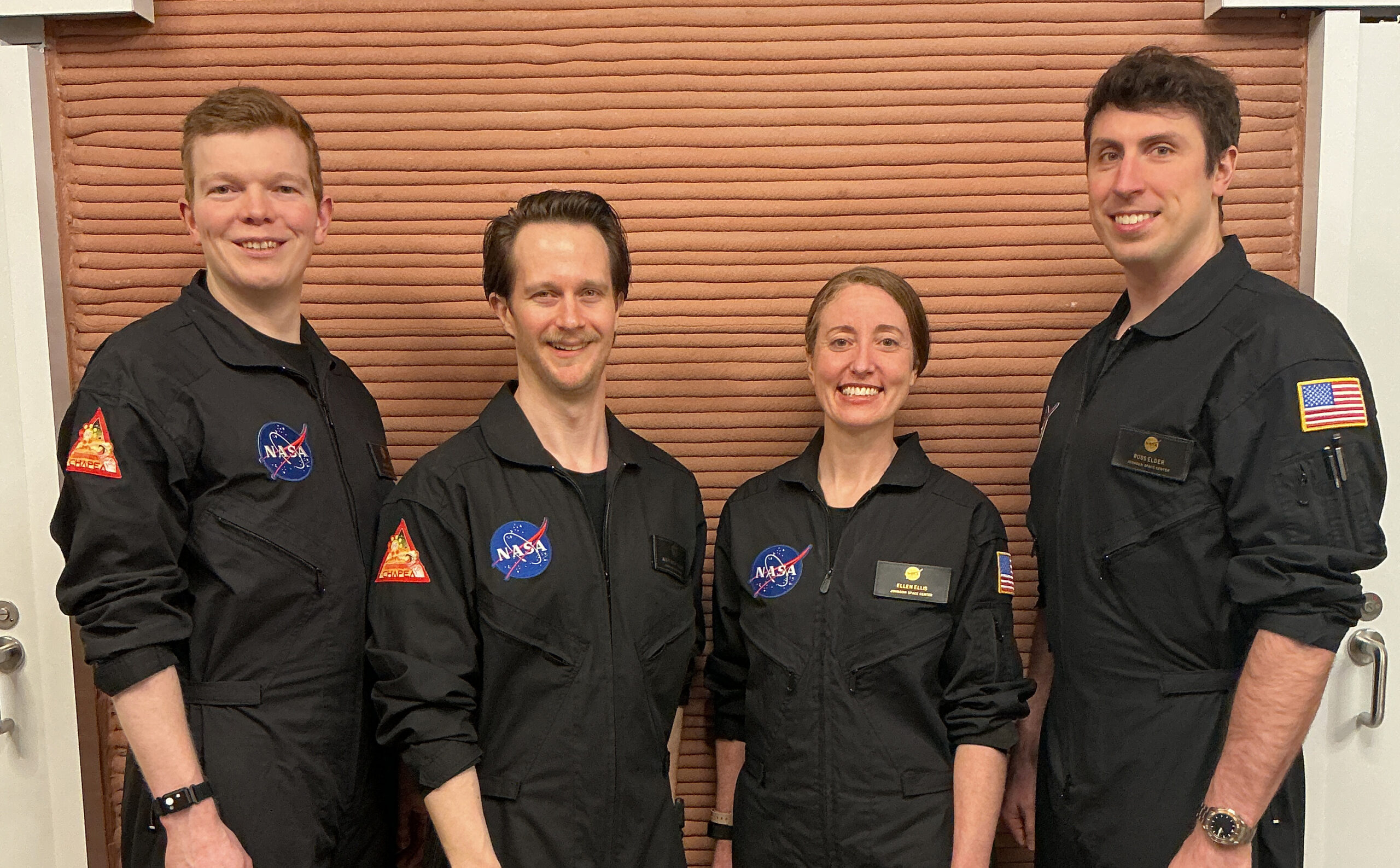
CHAPEA Mission 2 crew members James Spicer, Matthew Montgomery, Ellen Ellis, and Ross Elder (left to right) in their workspace after about a year inside the simulated Mars habitat at NASA’s Johnson Space Center in Houston. Credit: NASA. Public domain.
Sources
Sources
- NASA Invites Media to Crew Completion of Yearlong Mars Simulation — NASA media advisory M26-083, October 27, 2026. Consulted 2026-11-02.
- NASA’s Simulated Mars Crew Marks One Year Inside Habitat — NASA Human Research Program article, October 19, 2026. Consulted 2026-11-02.
- CHAPEA Mission 2 — NASA CHAPEA Mission 2 overview page. Consulted 2026-11-02.
- Crew Health and Performance Exploration Analog (CHAPEA) — NASA CHAPEA program page. Consulted 2026-11-02.
- CHAPEA Mission 2 Egress Event — NASA Johnson live stream of the October 31, 2026 exit ceremony. Consulted 2026-11-02.