Stars are the universe’s oxygen factories. So when astronomers add up how much oxygen the stars in a galaxy should have made over its lifetime, they expect to find most of it still there, in the gas, the dust and the stars themselves. In small galaxies near the Milky Way, a new study finds that most of it is gone.
In a paper published Monday in The Astrophysical Journal, a team led by Kristen McQuinn of the Space Telescope Science Institute and Rutgers University used archival Hubble Space Telescope data to take an oxygen census of 37 nearby dwarf galaxies. On average, those galaxies hold on to only about 11% of the oxygen their stars have produced. The rest has apparently been blown out by the explosions of massive stars, and far more efficiently than today’s computer models predict.
Why count oxygen?
The project is called GLOW, short for Galaxies Losing Oxygen via Winds. Oxygen is the most abundant element after hydrogen and helium, it is relatively easy to measure, and astronomers understand how stars make it. That makes it a practical stand-in for all the heavier elements, or “metals,” that stars forge and scatter.
“Oxygen is one of the primary elements formed by stars. Being able to trace how much oxygen gets made, and then how much is distributed inside and outside of galaxies, helps us understand galaxy evolution,” McQuinn said in NASA’s announcement.
How the census worked
The 37 galaxies are all gas-rich, star-forming dwarfs within about 6 megaparsecs, or roughly 20 million light-years, of us. Their stellar masses range from about 3 million to 3 billion times the mass of the Sun. That is the range where theory says supernova-driven winds should start to strip galaxies of their metals. They are also close enough for Hubble to pick out individual stars, which most known dwarf galaxies are not.
Resolving individual stars lets astronomers reconstruct each galaxy’s star-formation history, and from that estimate how much oxygen its stars should have produced in total. The team then measured where oxygen sits today. They used Hubble imaging for the stars, radio data from the Very Large Array and the Australia Telescope Compact Array for the gas, and the retired Spitzer Space Telescope, among other sources. Dust was estimated from how much oxygen is expected to stick to dust grains.
The 37 GLOW galaxies retained between about 4% and 25% of the oxygen their stars made. The average was 10.7%, and 29 of the 37 kept 15% or less.
Almost all the oxygen that remains is in the galaxies’ gas. Very little is locked in their stars or dust.
Where did the rest go?
“We know that the oxygen had to be inside of the galaxies at some point in the past, so the oxygen must have been ejected,” said co-investigator Grace Telford of the University of Utah. “And to do that, you need energy from massive stars and supernova explosions to drive material out of the host galaxies and into the space between galaxies.”
The exact destination is still open. Earlier studies of the gas halos around dwarf galaxies, called the circumgalactic medium, found ionized oxygen there. But the paper estimates that hot halo gas holds only 1% to 7% of the oxygen these galaxies produced, and perhaps 5% to 35% once cooler gas phases are included. That leaves open the possibility that a large share has escaped entirely into intergalactic space, making dwarf galaxies a significant source of the metals found between galaxies.
A problem for the simulations
The result is awkward for cosmological simulations. The authors compared their measurements with three sets of hydrodynamical simulations. All of them reproduce a well-known pattern, the relationship between a galaxy’s mass and its metal content. Yet all three predict that real dwarf galaxies should keep much more of their metals than GLOW measures, in some cases by a factor of a few.
Some results also run against intuition. The amount of oxygen a galaxy retained did not track neatly with its mass or its position on that mass-metal relationship. Environment seems to matter instead. Dwarfs more than about 3 million light-years (1 megaparsec) from a large neighbor consistently kept less than 15% of their oxygen. Those closer to a big galaxy, or in denser surroundings, showed a wider spread and sometimes kept more. The authors suggest that ejected metals may be recycled or picked up more easily there, though they stress the sample is small.
A simple model in the paper fits the data if the winds leaving these galaxies carry about twice the metal concentration of the gas left behind, and if the galaxies take in about 40% less fresh gas from intergalactic space than the cosmic average would suggest.
What comes next
McQuinn has an approved program to use NASA’s newly launched Nancy Grace Roman Space Telescope to find even fainter, lower-mass dwarf galaxies nearby, then follow them up with Hubble and the James Webb Space Telescope. Telford plans to use Hubble to study the individual massive stars that make the oxygen and drive it out of some of the closest GLOW galaxies.
For now, the message from the census is simple: small galaxies are leaky. Most of what their stars forged has not stayed home, and the best current models do not yet explain why so much has escaped.
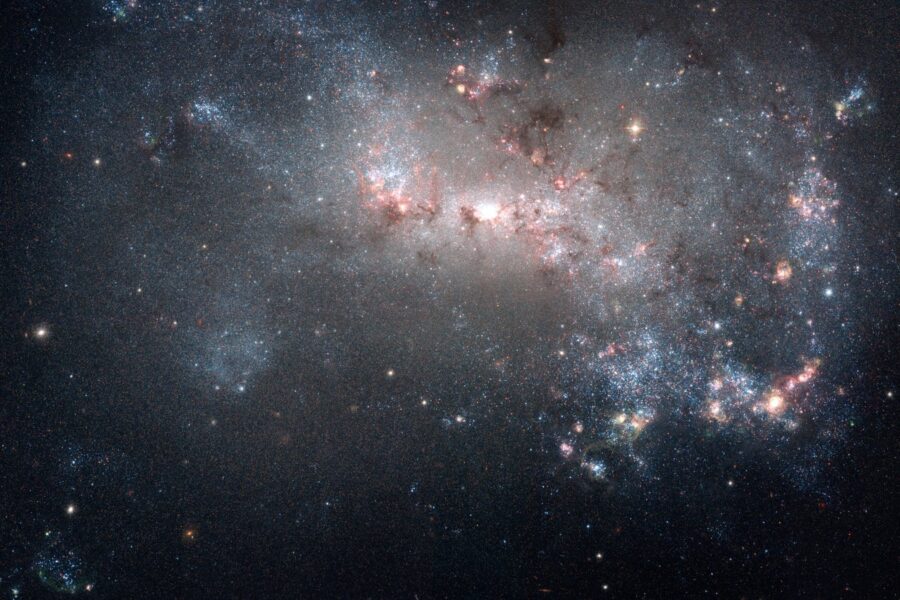
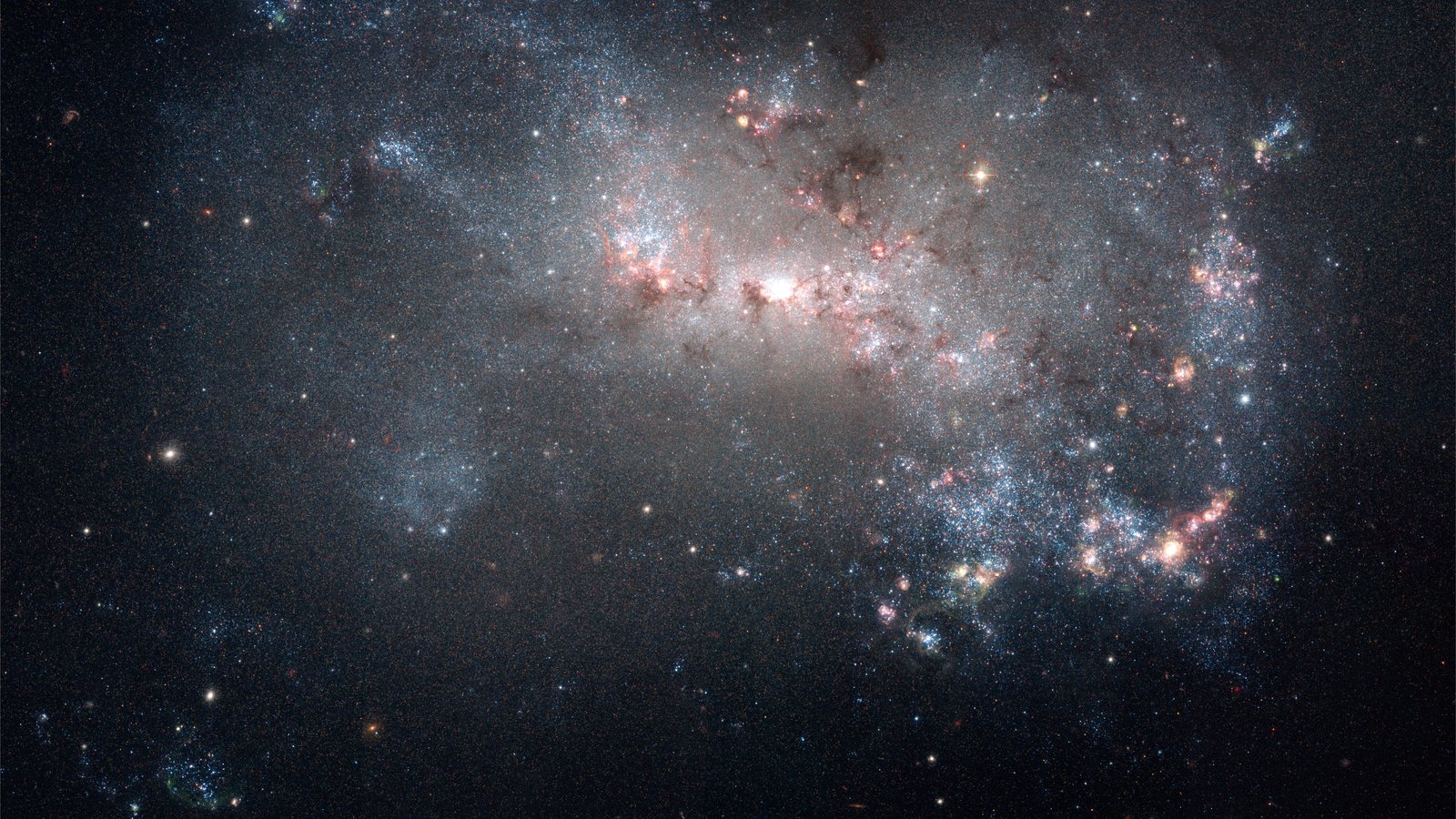
Image: Hubble image of the dwarf galaxy NGC 4449, one of the galaxies in the GLOW study. Credit: NASA, ESA, A. Aloisi (STScI/ESA) and the Hubble Heritage (STScI/AURA)-ESA/Hubble Collaboration.
Sources
Sources
- NASA’s Hubble Uncovers Case of Missing Oxygen in Nearby Dwarf Galaxies — NASA Science, November 2, 2026. Consulted 2026-11-02.
- GLOW II: A Census of Oxygen in Low-Mass Galaxies (McQuinn et al.) — arXiv:2608.07665, accepted to The Astrophysical Journal. Consulted 2026-11-02.
- Stellar fireworks are ablaze in galaxy NGC 4449 — ESA/Hubble image heic0711a. Consulted 2026-11-02.