On January 14, 2025, at 08:22:03 UTC, a faint tremor in spacetime passed through the two LIGO observatories in Hanford, Washington, and Livingston, Louisiana. It had been traveling for more than a billion years. The signal, later named GW250114, came from two black holes, each roughly 33 times the mass of the Sun, spiraling together and merging into one.
Mergers like this are now routine for gravitational-wave astronomy. What made GW250114 special was its clarity. Its network signal-to-noise ratio was about 80, making it the clearest signal recorded at the time and roughly three times louder than GW150914, the first detection in September 2015. That clarity allowed the LIGO-Virgo-KAGRA collaboration to test two key predictions about black holes using real data, which the collaboration published in Physical Review Letters on September 10, 2025.
Why “louder” is so valuable
In gravitational-wave astronomy, “louder” doesn’t refer to sound. It means the signal stands out more clearly against the noise in the detectors, which comes from seismic shaking, thermal jitter in the mirrors, and the quantum nature of the laser light. LIGO’s detectors measure changes in the length of their 4-kilometer arms that are far smaller than a proton.
Most detected signals are faint enough that scientists can learn the masses and spins of the black holes but not much more. GW150914 and GW250114 came from similar systems, both about 1.3 billion light-years away. The main difference is the detectors. A decade of upgrades lowered LIGO’s noise so much that the same kind of event now produces a much sharper record. Virgo was undergoing routine maintenance and KAGRA was not observing at the time, so the result comes from the two LIGO sites alone.
The two black holes in GW250114 were about 33.6 and 32.2 solar masses, had low spins, and moved on nearly circular orbits, according to the LIGO-Virgo-KAGRA paper.
Test one: does the horizon area grow?
In 1971, Stephen Hawking proved a theorem about black holes under general relativity: the total area of event horizons can never decrease. It is often called the second law of black hole mechanics, because it closely resembles the rule that entropy never decreases. The theorem later became a foundation for the idea that black holes have entropy proportional to their horizon area.
When two black holes merge, the final black hole has less mass than the two original ones combined, since some of the energy escapes as gravitational waves. So it is not obvious that the horizon area grows. The theorem says it must.
To test this, the team divided the signal into parts. They used the inspiral, the part of the signal before the black holes touch, to estimate the masses, spins, and horizon areas of the two original black holes. Then they used the ringdown, the fading signal after the merger, to estimate the mass, spin, and horizon area of the final black hole. They left out the most intense merger cycles in the middle, so the before and after measurements are independent. Even when up to five of the strongest cycles were removed, the final area was larger than the combined starting area with high credibility.
A similar test was carried out with GW150914 in 2021, but it gave a weaker result. GW250114 is clear enough that the area law holds even when the most extreme part of the merger is left out.
Test two: does the remnant ring like a Kerr black hole?
General relativity predicts that once a newly formed black hole settles down, it is described by just two numbers: its mass and its spin. This solution, worked out by Roy Kerr in 1963, means the black hole’s ringdown should follow a specific set of tones called quasinormal modes, with frequencies and decay rates set by those two numbers.
Measuring more than one of these tones is called black hole spectroscopy. It is like identifying a bell from its overtones as well as its main pitch. In GW250114, the team found at least two distinct modes in the post-merger data at 4.1 sigma credibility: the main quadrupole tone and its first overtone. Both matched the predictions for a Kerr black hole, with the overtone’s frequency consistent to within about 30 percent.
If the final object had been something more exotic than a Kerr black hole, or if general relativity failed in strong gravity, the tones could have been different. They were not, at least not at this level of precision.
What the result does not show
These results agree with general relativity, but they don’t prove it beyond doubt. A 30 percent constraint on a mode frequency is a significant step, but it’s still loose compared to tests of gravity in the solar system. Researchers also debate how early in the ringdown the simple “sum of tones” model applies. The collaboration addressed this by testing several start times and leaving out the peak of the signal, and promised a separate follow-up paper on the issue.
The area-law test also relies on modeling. The before and after horizon areas come from fitting the data to waveform models based on general relativity. This is the standard approach, but it means the test checks for consistency within the theory, not against an independent theory.
Finally, this is just one event. Stronger claims will need more loud signals or many fainter ones combined.
What comes next
The fourth observing run, O4, began on May 24, 2023, and ended on November 18, 2025. It was the longest run so far. About 250 candidate signals were reported in real time, and the GWTC-4.0 catalog has confirmed 128 significant events from just the first of three segments. The rest of the data is still being analyzed. Across all runs, the LIGO-Virgo-KAGRA network has made more confident detections in O4 than in the previous three runs combined.
The observatories are now in a planned break for maintenance and upgrades. When O4 ended, the collaboration said it hoped to start a roughly six-month run in late summer or early fall of 2026. That has slipped: the latest public observing plan, updated in October 2026, targets a mid-January 2027 start for the interim run, called IR1, with the two LIGO detectors and Virgo taking part and KAGRA joining later if it can. Upgrade schedules often change, so that date should be treated as a target, not a promise.
Future detectors will be much more sensitive. Proposed next-generation observatories like Cosmic Explorer in the United States and Einstein Telescope in Europe, along with ESA’s planned space-based LISA mission, aim to detect many signals as clear as GW250114 or clearer. If that happens, black hole spectroscopy could move from a few tones to a full set, and small deviations from Kerr’s solution, if there are any, could become measurable.
For now, GW250114 is a milestone. Ten years after the first detection, gravitational-wave astronomy has progressed from simply detecting black holes to testing what they are, and both Hawking’s and Kerr’s predictions still hold.
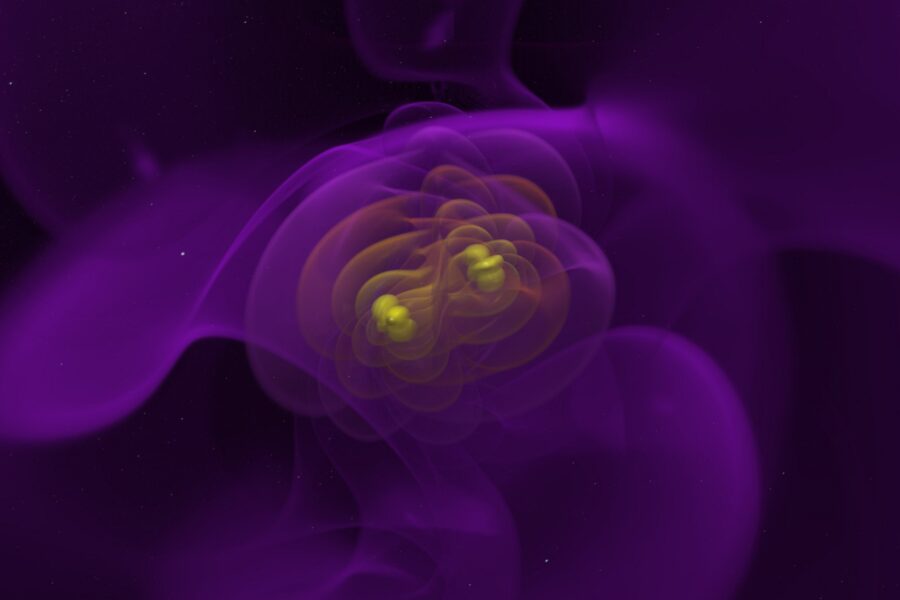
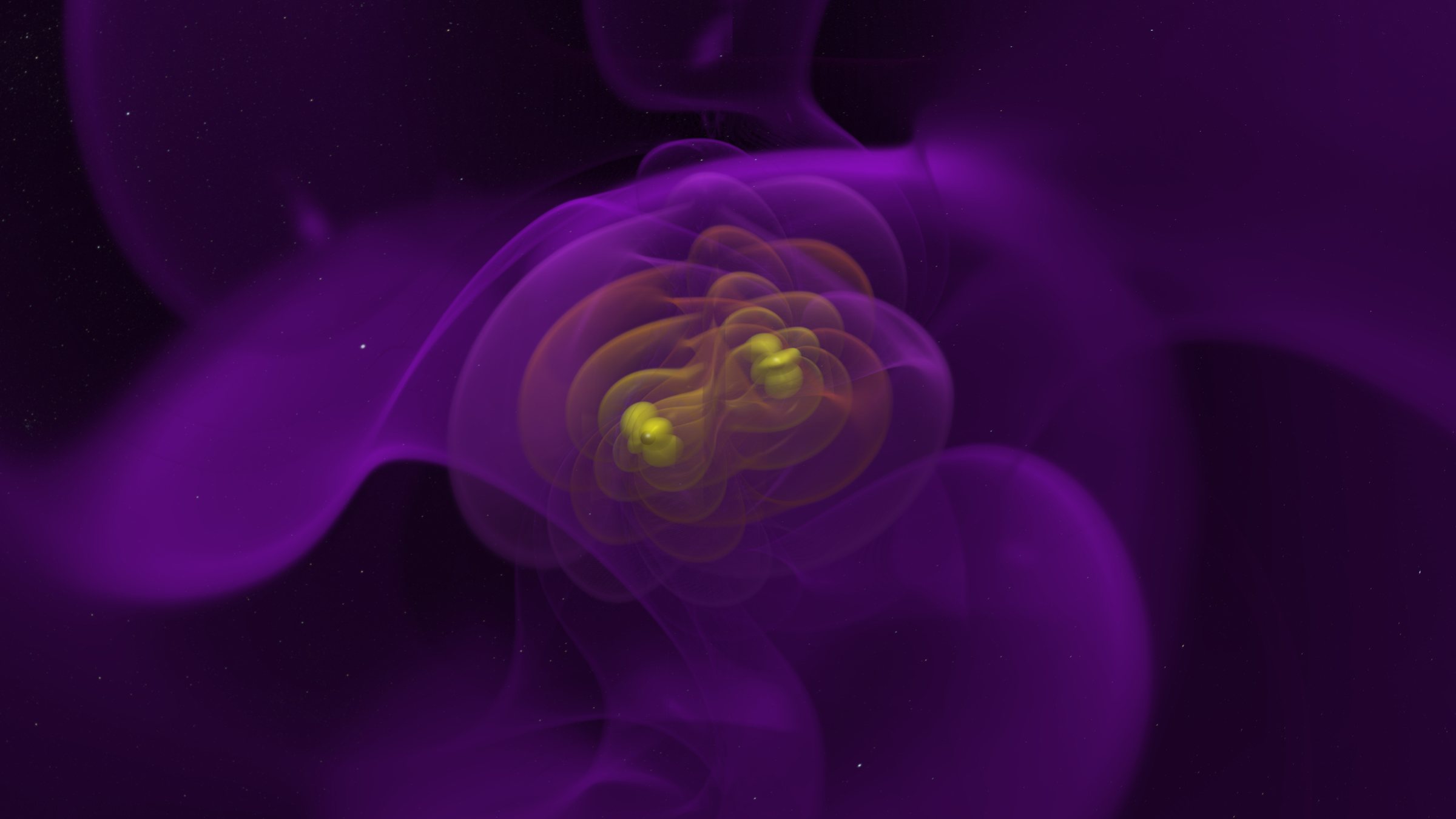
Image: NASA/Ames Research Center/C. Henze; science: Bernard J. Kelly (UMBC), NASA Goddard Scientific Visualization Studio (SVS 13197). Visualization of a generic equal-mass merger, not GW250114 itself.
Sources
Sources
- GW250114: testing Hawking’s area law and the Kerr nature of black holes (LIGO-Virgo-KAGRA) — Physical Review Letters, September 10, 2025. Consulted 2026-10-31.
- GW250114: Testing Hawking’s Area Law and the Kerr Nature of Black Holes (public PDF, LIGO-P2500421) — LIGO Document Control Center. Consulted 2026-10-31.
- GW250114: 10 years of gravitational-wave astronomy — LIGO Scientific Collaboration. Consulted 2026-10-31.
- Black hole spectroscopy and tests of general relativity with GW250114 (science summary) — LIGO Scientific Collaboration. Consulted 2026-10-31.
- LIGO-Virgo-KAGRA Collaboration successfully wraps up its fourth Observing Run — LIGO Scientific Collaboration, November 2025. Consulted 2026-10-31.
- APOD: GW250114: Rotating Black Holes Collide — NASA APOD, September 24, 2025. Consulted 2026-10-31.
- Gravitational Wave Simulations of Merging Black Holes — NASA Scientific Visualization Studio. Consulted 2026-10-31.
- LIGO, Virgo and KAGRA Observing Run Plans — IGWN, October 15, 2026 update. Consulted 2026-10-31.