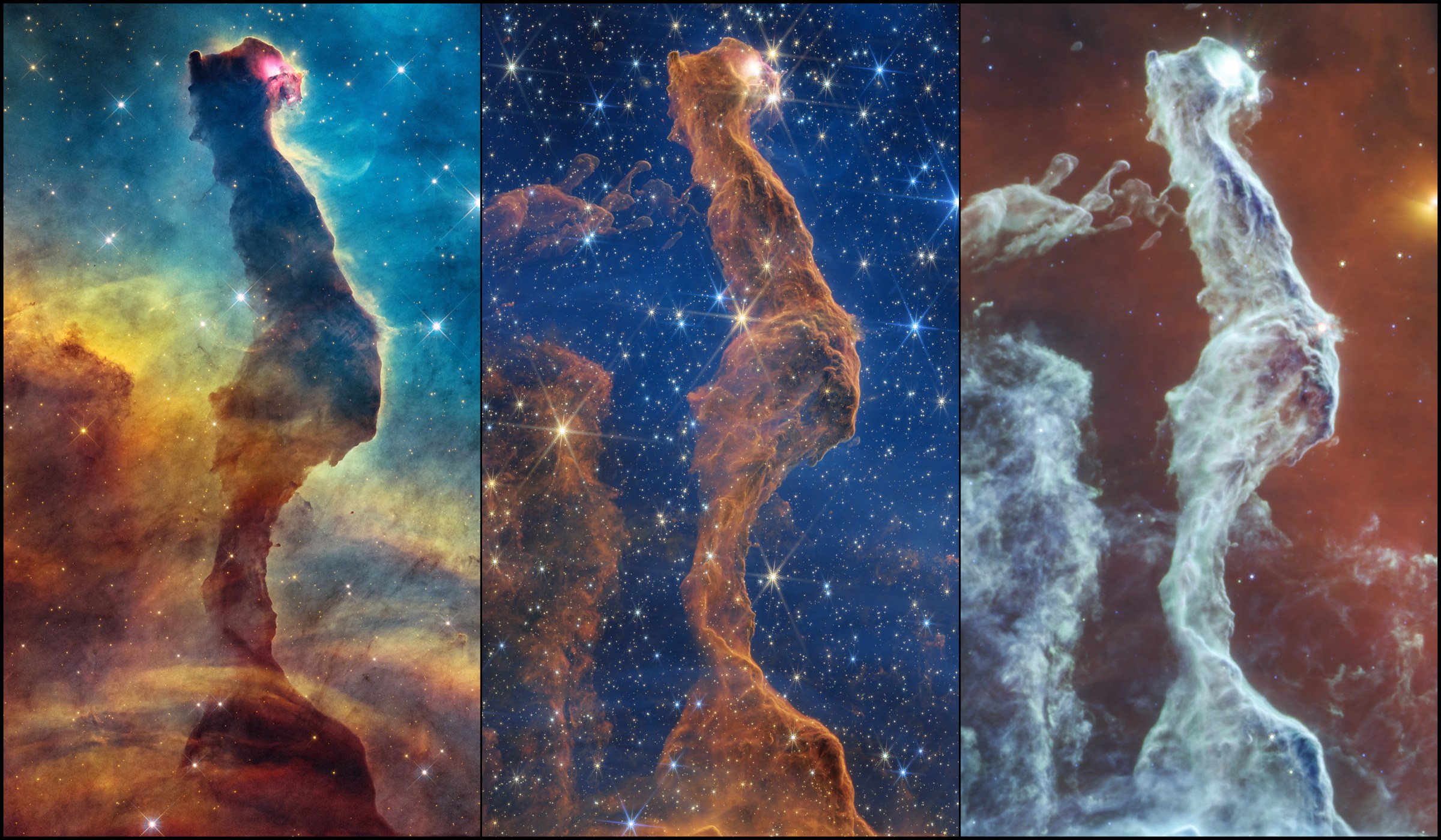
Two of the world’s flagship space telescopes have turned toward the same small patch of the Carina Nebula, and both found a cat. The newly released views from the Hubble Space Telescope and the James Webb Space Telescope show a dark, towering pillar of gas and dust that astronomers have nicknamed the Cat’s Head Nebula.
ESA and NASA published the images on October 29, 2026. The pillar sits inside the Carina Nebula, a vast star-forming cloud roughly 7,500 light-years from Earth. Seen in the right light, the structure resembles a cat sitting with its back to the viewer, its head turned to the right and one glowing “eye” looking out.
The images are more than a seasonal curiosity. Hubble sees the pillar in visible light, while Webb looks at it in near- and mid-infrared light. Together they show different layers of the same scene, from the glowing gas on its surface to the young stars buried inside it.
How a dust pillar gets its shape
According to the ESA release, the cat’s distinctive outline was likely sculpted over time by intense ultraviolet radiation and stellar winds from the massive stars of the Carina Nebula. That process, which astronomers call stellar feedback, erodes the surrounding gas and dust. Denser material inside the pillar resists the erosion longer, leaving the feline shape standing, at least for now.
That last caveat matters. The agencies describe the Cat’s Head Nebula as a temporary scene that will eventually disperse as stars form and evolve. What we see is a snapshot of an ongoing process, not a permanent feature of the sky.
What Hubble sees
In Hubble’s visible-light image, taken with its Wide Field Camera 3, the cat appears as an opaque, dark brown column of dust. Its glowing red eye may mark a young star that is still partly embedded in the dust, the release says.
A hazy yellow ridge runs along the right edge of the filament. The release notes that this bright rim is consistent with gas being heated and ionized by ultraviolet light from nearby massive stars, which could be driving photoevaporation, the slow boiling-away of the pillar’s outer layers. Hubble’s filters capture light from oxygen, hydrogen and sulfur, along with starlight scattered by dust, so the shifting blues, yellows and reds trace a mix of excited gas, dust and stellar light.
What Webb adds
Webb’s near-infrared camera, NIRCam, sees through much of that dust. The pillar becomes more transparent and its complex surface texture comes into view. Ghostly wisps of gas and dust appear on the cat’s left side, and a dense scattering of stars fills the frame.
Even in infrared light, some stars remain wrapped in dust to varying degrees. The cat’s eye is still the most obvious example of an embedded star. A faint, jet-like feature near the cat’s “belly” hints that another young star lies nearby, perhaps inside the pillar or just outside it to the right. The release presents this as a possibility rather than a confirmed detection.
Webb’s Mid-Infrared Instrument, MIRI, shows yet another layer. At these wavelengths, warm dust and carbon-based molecules outline delicate strands and globules. The pillar’s bluish and greenish tones highlight emission that includes polycyclic aromatic hydrocarbons, or PAHs, carbon-rich molecules excited by starlight. The release cautions that the color differences may reflect changes in PAH emission, dust and local radiation rather than temperature alone.
To the right of the pillar, a bright source glows yellow in the MIRI view, and a narrow filament appears to cross in front of it. ESA is careful to note that the image alone cannot establish whether the two are physically connected.
Why two telescopes are better than one
Star formation happens inside clouds that block visible light, which is why combining telescopes is so useful. Hubble shows how ultraviolet light from massive stars is carving and heating the pillar’s surface. Webb reveals the stars that are forming, or have recently formed, behind that surface.
This is an image release rather than a new research result. Still, according to ESA, the complementary views are helping astronomers learn more about what it calls the “elusive, chaotic, and complex” process of star formation, one dust pillar at a time.
Image: Cat’s Head Nebula in the Carina Nebula as seen by Hubble’s WFC3 (left), Webb’s NIRCam (center) and Webb’s MIRI (right). Colors are assigned to different wavelengths of light. Credit: NASA, ESA, CSA, STScI; image processing: Joseph DePasquale (STScI). Via ESA/Webb (weic2622a), CC BY 4.0.
Sources
Sources
- Ghostly Cat’s Head Nebula lurks within sight of Hubble and Webb — ESA/Webb photo release weic2622, October 29, 2026. Consulted 2026-11-01.
- Ghostly Cat’s Head Nebula lurks within sight of Hubble and Webb — ESA, October 29, 2026. Consulted 2026-11-01.
- Hubble release heic2614 — ESA/Hubble, October 29, 2026. Consulted 2026-11-01.
- NASA’s James Webb Space Telescope Captures Eerie Cat’s Head — NASA, October 30, 2026. Consulted 2026-11-01.
- Ghostly Cat’s Head Nebula Lurks Within Sight of NASA’s Hubble, Webb — NASA Science. Consulted 2026-11-01.
- Cat’s Head Nebula (Hubble WFC3, Webb NIRCam, and Webb MIRI images) — ESA/Webb image page. Consulted 2026-11-01.