NASA is asking private companies a question that would have sounded unusual a decade ago: could one of them fly up to the Hubble Space Telescope and push it higher? On October 29, 2026, the agency issued a Request for Information to learn what industry could offer for in-space servicing of the 36-year-old observatory.
A Request for Information is not a contract or a mission approval. It is a formal way for an agency to survey what is possible before deciding anything. Still, it signals that NASA wants to keep Hubble’s options open.
Three options on the table
According to NASA, the request seeks commercial interest in three kinds of work. The first is a mission to boost Hubble to a higher altitude to extend its science lifetime. The second is servicing Hubble to enhance its capabilities. The third is performing a safe, controlled re-entry into Earth’s atmosphere, or another form of orbital disposal, when the mission ends.
Responses are due by 3 p.m. EST on Monday, November 30, 2026.
“Hubble still has important science ahead of it, and we should be looking at every reasonable opportunity to keep it delivering for as long as possible,” NASA Administrator Jared Isaacman said in the agency’s announcement. “If there are innovative and cost-effective ways to extend the life of an asset already on orbit, we owe it to the American taxpayer and the scientific community to explore them.”
A slowly sinking telescope
Like every spacecraft in low Earth orbit, Hubble is gradually losing altitude because of drag from the thin upper atmosphere. It has no propulsion system of its own to raise its orbit. NASA says its analysis predicts Hubble is likely to re-enter the atmosphere in the 2033 to 2034 timeframe, so any mission would need to take place by 2032.
Hubble launched in 1990 and was visited by astronauts on five space shuttle servicing missions, the last in 2009. No mission has visited it since. NASA is now asking whether newer commercial vehicles could fill that gap.
“Commercial industry has rapidly evolved in recent years to offer new capabilities for in-space satellite capture and servicing,” said Nicky Fox, associate administrator of NASA’s Science Mission Directorate. “Given the time we have until Hubble’s anticipated re-entry, we are eager to explore the breadth of possibilities to boost Hubble to a higher orbit while we develop the flagship mission to follow.”
Not the first look at a reboost
The idea has been studied before. In September 2022, NASA and SpaceX signed an unfunded Space Act Agreement to study a SpaceX and Polaris Program concept for using a Dragon spacecraft to boost Hubble into a higher orbit. At the time, NASA said it had no plans to conduct or fund a servicing mission.
In June 2024, while announcing that Hubble would switch to operating with a single gyroscope to keep observing, NASA said it would not pursue a reboost at that time. Mark Clampin, NASA’s astrophysics director at the time, said the assessment had raised “potential risks such as premature loss of science and some technology challenges,” and that more work was needed to judge whether long-term returns would outweigh short-term risks.
Isaacman, whose Polaris Program proposed the Dragon reboost idea, now runs the agency. The new request does not commit NASA to any of the three options, but it formally reopens the question with a clear deadline: whatever happens has to happen within the next several years.
What happens next
NASA will review the responses after the November 30 deadline. The agency has not announced a budget, schedule or selection process for any resulting mission. If no reboost or servicing flight goes ahead, the request also covers the other end of Hubble’s story: making sure the telescope comes down safely.
For now, Hubble keeps working. It is a joint project of NASA and ESA, managed by NASA’s Goddard Space Flight Center, with science operations run by the Space Telescope Science Institute in Baltimore.
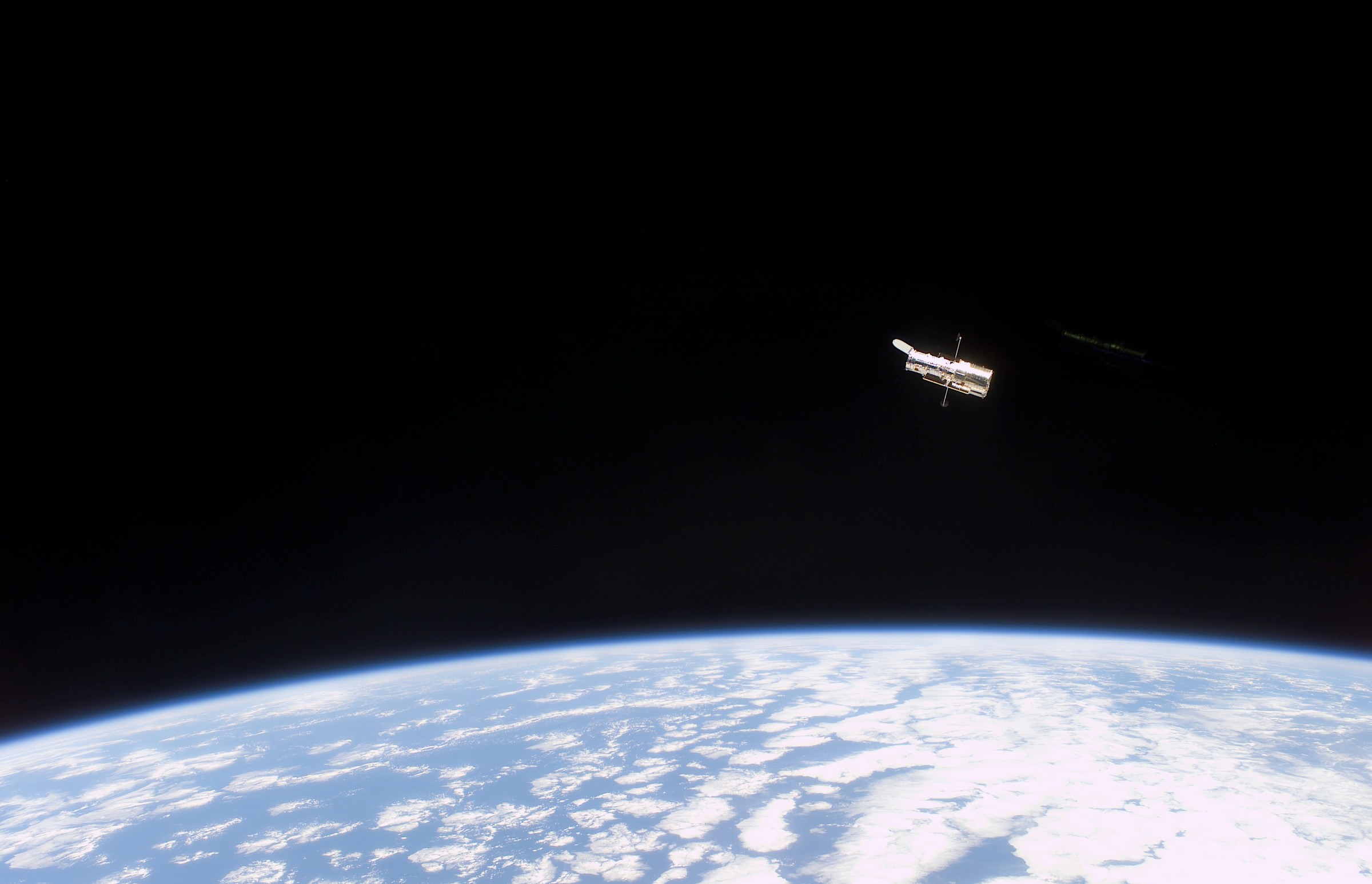
Image: The Hubble Space Telescope drifts away from Space Shuttle Columbia above Earth after its release on March 9, 2002, at the end of servicing mission STS-109. Credit: NASA (STS109-E-5707).
Sources
Sources
- NASA Explores Potential Commercial Servicing for Hubble Telescope — NASA Science, October 30, 2026. Consulted 2026-11-01.
- NASA, SpaceX to Study Hubble Telescope Reboost Possibility — NASA, September 2022. Consulted 2026-11-01.
- NASA to Change How It Points Hubble Space Telescope — NASA Science, June 2024. Consulted 2026-11-01.
- Despite gyro failure, NASA says Hubble Space Telescope still up to world-class science — Spaceflight Now, June 5, 2024. Consulted 2026-11-01.
- HST deployed after repairs (STS109-E-5707) — NASA Image and Video Library. Consulted 2026-11-01.
- Hubble Space Telescope mission page — NASA. Consulted 2026-11-01.