Inside NASA’s Perseverance rover, in a sealed titanium tube about the size of a stick of chalk, sits a core of Martian rock called Sapphire Canyon. NASA calls it the mission’s best candidate so far for preserving signs of ancient microbial life. Whether it actually does may not be known for a long time, because the mission meant to bring it to Earth no longer exists.
A rock with leopard spots
Perseverance found the source rock, nicknamed Cheyava Falls, in July 2024 in an area called Bright Angel along Neretva Vallis, an ancient river valley that once fed a lake in Jezero Crater. The reddish mudstone was covered in small, light-colored spots with dark rims that the team called leopard spots.
The rover’s instruments showed that the spot rims contain two iron-rich minerals: vivianite, an iron phosphate, and greigite, an iron sulfide. On Earth, vivianite often forms in sediments around decaying organic matter, and some microbes produce greigite. The minerals appear to have formed through electron-transfer reactions between the sediment and organic carbon, the kind of chemistry that some microbes use for energy.
The analysis was published in Nature on September 10, 2025. NASA’s release used careful language: the sample contains a potential biosignature.
NASA defines a potential biosignature as a substance or structure that might have a biological origin but requires more data or further study before a conclusion can be reached.
Why “potential” is doing real work
The same minerals can form without life. NASA lists sustained high temperatures, acidic conditions, and binding by organic compounds as possible non-biological routes. The team found no evidence that the Bright Angel rocks experienced high heat or acidity. However, scientists do not yet know if the organic compounds present could drive these reactions at low temperatures.
That is where Perseverance runs out of tools. The rover can map minerals and detect organic material, but it cannot measure detailed isotopes, image structures at the nanometer scale, or run many other tests that laboratories on Earth can. Those are the tests most likely to tell biology from chemistry, and they need the sample in a lab.
The return mission that was canceled
For over a decade, NASA and ESA planned to retrieve Perseverance’s sample tubes with a lander, a small rocket called the Mars Ascent Vehicle, and ESA’s Earth Return Orbiter. In April 2024, NASA said the architecture was too expensive and too slow, with estimates of up to $11 billion and samples arriving around 2040. The agency studied cheaper options in 2024 and 2025.
In January 2026, Congress passed NASA’s fiscal 2026 budget with no funding for Mars Sample Return. The Planetary Society, which tracks space policy, describes the program as formally canceled. Congress also set aside $110 million for a new Mars Future Missions line to develop technologies for future exploration. That money is not the same as an approved sample-return mission with a lander, rocket, or schedule.
Still drilling
Perseverance is still working. The rover landed in February 2021 and has continued to explore, sample, and seal rock cores on Mars. As The Planetary Society put it, the samples still sit in the rover and in caches on the surface.
There are several possible next steps. A future Congress could fund a new architecture. Commercial providers or international partners could propose cheaper options. Other nations’ Mars sample efforts, including China’s planned Tianwen-3, could also change the political picture. None of these is an approved plan to bring back Sapphire Canyon.
For now, the scientific situation is stable even if the policy situation is not. Cheyava Falls remains one of the most intriguing rocks ever studied on another planet, and there is a sample of it sealed and waiting. What’s missing is a way to get it to Earth.
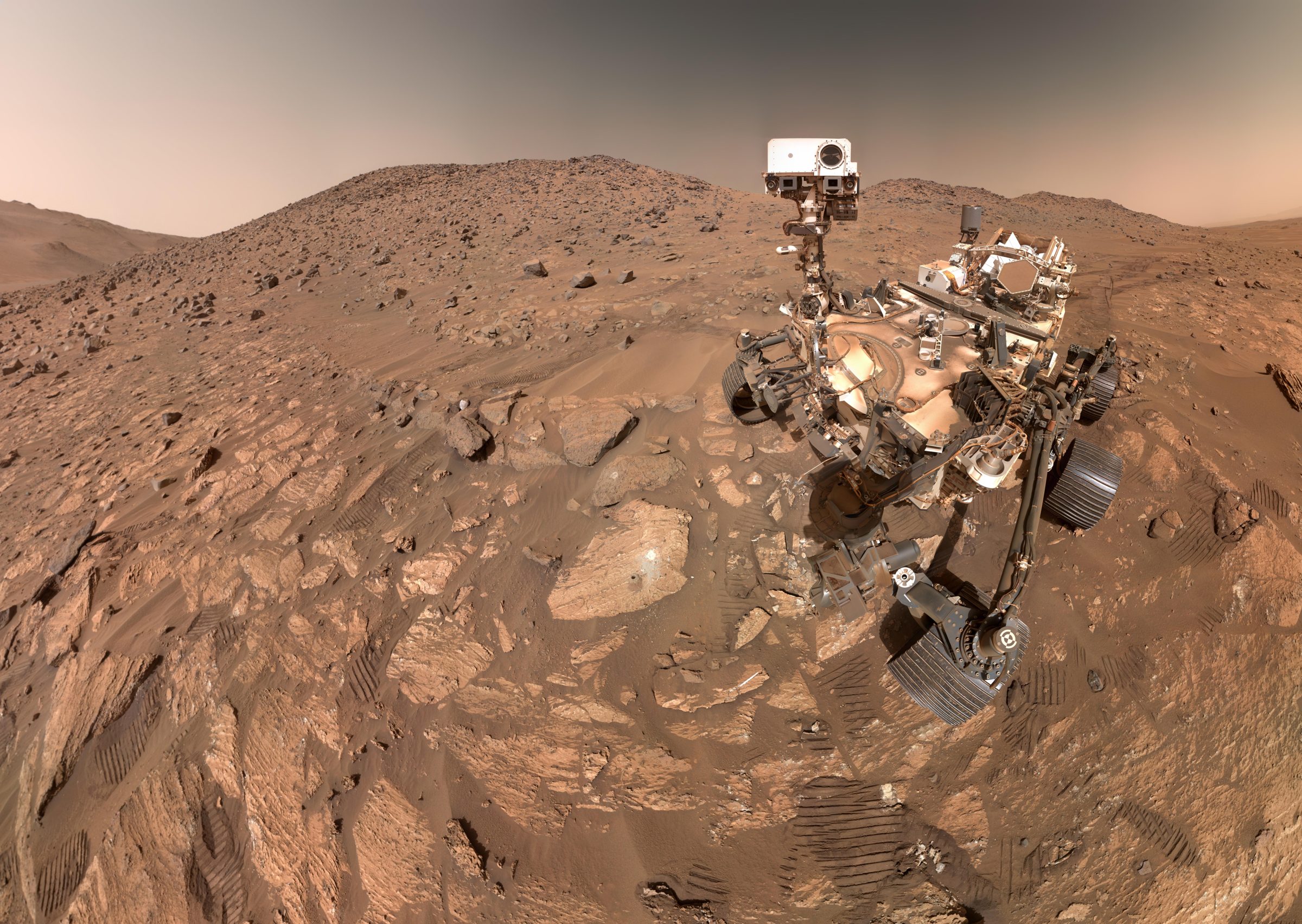
Image: NASA/JPL-Caltech/MSSS (PIA26344).
Sources
Sources
- NASA Says Mars Rover Discovered Potential Biosignature Last Year — NASA, September 10, 2025. Consulted 2026-10-31.
- NASA Says Mars Rover Discovered Potential Biosignature Last Year — NASA JPL. Consulted 2026-10-31.
- NASA is funded. Now what? — The Planetary Society, January 30, 2026. Consulted 2026-10-31.
- Mars Sample Return — The Planetary Society. Consulted 2026-10-31.
- A ‘potential biosignature’ on Mars has an uncertain future — CNN, October 12, 2026. Consulted 2026-10-31.
- Perseverance’s Selfie With ‘Cheyava Falls’ (PIA26344) — NASA/JPL-Caltech/MSSS. Consulted 2026-10-31.